Monday, April 16, 2012

Annotated Bibliography


These books will be to supplement a microbiology unit.  In this unit will cover bacteria and viruses.  These have shaped our history and they will continue to shape our future.  First students will need to know anatomy of cells and viruses and the mechanisms that create diseases.  Then we will need to emphasize that not all bacteria are and viruses are harmful to humans and that there are a select few that are harmful. 
The trade books contain much of the same factual information that the students will learn in a textbook, but it is delivered in a story telling way.  Students will be able to read this more readily rather than trying to read a book that is focusing on just delivering facts and vocabulary words.  The trade books also focus on the social impact of disease and there fore will show students how the world of cells and viruses have shaped our world.
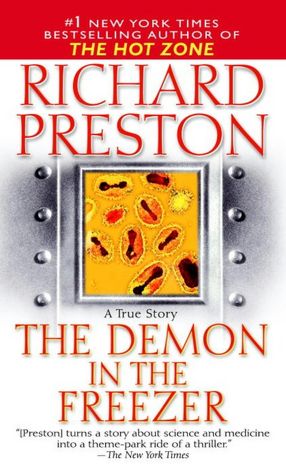


Demon in the Freezer
          Smallpox is the only disease that has ever had a god as its consequence. This books central theme is about biowarfare.   It starts out describing the 2001 terrorist attack of sending a letter to a US senator killing 5 people as a consequence.  The book lead into talking about small pox because a major concern with the letter was that the Anthrax was laced with smallpox, but it was not.  It talked about the history of small pox from the origination of a transpecies jump to humans many years ago when agrarian life was first established, the eradication of smallpox and to modern day experimentation with it.  The Eradication was talk about in great depth and how they used a ring pattern of immunizations to stop the spread.  The modern perspective is the about smallpox research and the individuals that wanted to research a more effective and safer vaccination.
            This is for the students that are more science oriented.  It is a fascinating book that describes diseases in great detail. Students will need to be introduced to some of the topics about disease and viruses.  This way a student will understand what spores are and how they are formed.  This book is a good supplemental reading for students to read and incorporate into the learning of a subject.  Instead of having the students regurgitate the facts from the textbook they can use the context of the book for to support their explanations.


Henrietta Lacks,
          This is a documentary about Henrietta Lack, the women that the famous HeLa cells came from.  HeLa cells are a type of cancer cell that has a growth pattern that is like no other cell we have seen. They will continue to grow and divide as long as there are nutriance and will not die. This makes them very important in the medical research field.  The book starts out of a student that learned about where HeLa cells came from and from there on she wanted to learn more about his women that no one knew anything about.  We go on a journey with the author Rebecca Skloot tracking down the Lacks family and her doctors.  We find out that her cells were taken with out her permission and the struggles and inequalities that happen to the poor.  This book takes place in the heart of Baltimore and John Hopkins.
            This book, students will see things that they can connect with.  It takes place in Baltimore and at John Hopkins Hospital.  This is the stories of how just a few cells could shape science, as we know it.  With out these cells we would not have most of the cancer drugs and vaccines that we use to this day.  Once we would start to cover cells and how they divide we could start to read this book. Having the lesson cover how cells reproduce and what cancer it, this book will give them a more personal aspect to the lesson. It is always important for students to know how far we come. It will not show the leaps and bounds the science community has improved with its ethics, but still how much further we still have.
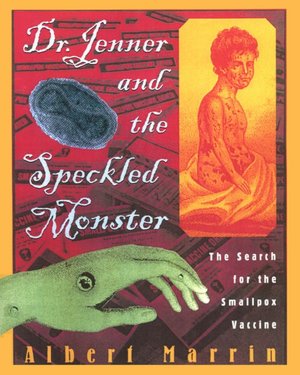

Dr. Jenner and the Speckled Monster
          This book focuses on the history of the smallpox disease.  The book starts out talking about the devastation that smallpox has had on many civilizations.  It is the only disease that had gods named after it.  The “Speckled Monster” gives a brief description on how the human smallpox arose.  I talks about how we moved from hunters and gatherers and how disease had a hard time taking a hold of a species until we became agrarian and kept livestock in close quarters with us, this lead to a virus jumping species.  Then it talked about Dr. Jenner, he was a surgeon, not a doctor, and was very studious about his work.  He met a milkmaid one day and she gave him the idea of vaccinating people with cowpox to prevent smallpox.  This was the start of his quest and it worked.  With his work we were able to use this same technique to complete the eradication of the smallpox virus.
            This book is written at a lower level then the other two novels that were selected for the microbiology lesson plan.  I would use this book with students that might not be reading on par with the grade level.  It will also be accessible to all students in the classroom for another reference book.  In the back it also lists some websites that would be useful to use in the class, to show how to research material like this.

Website 1, Anatomy of a cell
On this site there are pages for every part of the cell.  This has show easy to read and understand diagrams and pictures.  This site covers both animal and plant cell parts, so this site would be a one stop visit with the cell basics.
Sometimes explanations in textbooks are not as clear as students would like. This website is a great supplemental reading to either use in class or have the students explore outside of class for a further understanding of the subject. There are pages on this site that give an in depth reading on the parts of a cell and also provide labeled diagrams.

Website 2, Mitosis
            This site was designed by M. Davidson at the University of Florida for instructional use.  Here you can see all the phases of cell division.  These can all be seen in one layer of an onion skin under a microscope.  There are pictures under each of the description of the phases.  This provides a good understanding of what is happening in the mitosis in a cell.
A good hands-on lab where students get to see mitosis in progress is looking a layer of an onion.  Most labs have you draw out the stages of the cell in class and answer questions about cell division.  This would be a great reference before a test, so students can compare their drawings and notes of the onion cells to actual pictures.

1. Preston, Richard. (2003). The Demon in the Freezer: A True Story. Random House      Publishing Group.
2. Skloot, Rebecca. (2011). The Immortal Life of Henrietta Lacks. Crown Publishing Group.
3. Marrin, Albert. (2002). Dr Jenner and the Speckled Monster: The Search for the Smallpox Vaccine. Penguin Group (USA) Incorporated.

Sunday, March 25, 2012

pollution

Pollution

Pollution is a topic that is always in the media and even if we ignore that is we still can not hide from the fact that is is all around us.  This is a link to the EPA's website and on there there are links that explain what the different types of pollution are and how they are effecting us. I would like to use this site for a project resource. The students can pick a pollution topic and use this site as one of the suggested resources to the project.


Evolution

Evolution 101 is a site that has a great picture to text ratio.  This is essential to a lot of biological topic.  Picture are worth a million words.  I would ask the student to look at this as a homework assignment before I introduce the topic of evolution to the class.  This way students will come into the class hopefully having a better understanding about what evolution is. 


Sunday, March 11, 2012

Essential Question #3

How can young adult literature peak student's interest in science? 


          As I have been researching this question, I found an article that talks about teaching a class that mixes science fiction and science to introduce complex topics such as taxonomy and evolution.  When reading fiction novels the reader can be transported into other worlds and see things that their eyes could never see.  Using this these environments we can walk through different scenarios.  A teacher could ask students to find a creature in the novel and work on a taxonomy assignment.  They would have to be able to describe the animal and then identify what key characteristics they would use and place them into a classification of animals.  The students would have to read critically and be able to piece together enough information on the description on of animals to be able to properly classify them. 
            I am new to the Maryland school system and I don’t know how keen they are on evolution being taught in the classroom, but these books are great ways for students to get to thinking about, “hey how did that happen?”  Imagine if Earth were left a lone for a million years, what would happen?  Another thing would be talking about convergent evolution and talk about how these “space aliens” walk around on two legs and have opposable thumbs like us.  Using these science fiction novels there could be endless questions that could be applied to evolution.


Bixler, Andrea. (2007). Teaching evolution with the aid of Science Fiction. Retrieved from http://findarticles.com/p/articles/mi_6958/is_6_69/ai_n28470206/

Sunday, March 4, 2012

How Energy Moves, 2 sites

It is important for students to understand the flow of energy.  It gives prospective that there is nothing isolated in our world and how everything is linked in some way.

Water, Carbon and Nitrogen

This site is a great quick review site for student. Everything is explained in very basic terminology and would be great reference for students before an exam.  The pictures are great, they are not just basic black in white pictures, but very colorful with pictures of plants and animals.  I love to use multiple pictures to emphasize the same concept.


Food chains and webs


This site is meant for a high level of readers then the class I would be teaching this to, but it explains food webs and chains really well.  I would ask students to visit this site and primarily focus on the first section and if they would like to skim over the rest of the site and see if they see anything they would like to know more about in class. I would be a great site to stimulate questions in class and we could have a discussion to expand on some of the more complex language and topics on this site.

Sunday, February 26, 2012

Essential Question #2

          We all hear it in the classroom whether we think it’s true or not, “why do we have to do this?”  It is hard to get children to understand why we have to teach them what we do.  Trying to overcome this reluctance to want to learn is hard to achieve, but with the use of young adult literature we can help them by trying to relate the subject to them or so they can see how these subjects can potentially occur in their world.  Textbooks are very dense with material and it throws it at the reader all at once, but when the topic is brought up in a novel, then it delivers a message with ease and understanding of a plot line.
            An example of a book that is often used in a science based classroom setting is “Hot Zone.”  This book is written as if it was a fiction novel, but it is based on a true story.  The wording is easy to understand and give enough suspense to keep the reader enthralled by what could happen next.  This is a great book to introduce disease and microbiology to students.  It lets them know that these things are really out there and that is not just something that happens in third world countries, but can happen to places like where they live.  This book shows how it can drastically change people’s lives moments with something that we can not even see with the naked eye.

George, Marshall. (2001). What's the Big Idea? Integrating Literature in the Middle School. Retrieved from http://www.adlit.org/article/22976/

Stallworth, Joyce. (1998). The Young Adult Literature Course: Facilitating the Integration of Young Adult Literature into the High School English Classroom. Retrieved from http://scholar.lib.vt.edu/ejournals/ALAN/fall98/stallworth.html

Sunday, February 19, 2012

Essential Question #1: How can young adult literature peak students interest in science?

How can young adult literature peak student's interest in science?        

          Young adult literature approaches topics that are important to the reader.  Young adult literature focuses on an audiences between the ages of 12 and 20.  These books will often touch base in topics are important to them and using these books teachers can also cover topics that can convey to the classroom.  Most teacher often skip over science fiction as one of the genres covered, but it is important for students imagination to have that spark and realize we can expand much more on our current technology standard. 
          Most writers do not have a background in the science industry, but they are able to put into words what most imagine.  In these books there are usually some current scientific ideas, but then there are others where the truth is stretched.  Teachers can have students search the text to find what is science and what is science fiction. Most know Star Trek from the famous television series, but it is also a Science Fiction novel series.  There are some great examples of where ideas like the space-time continuum is talked about that Einstein originally conceived.  So literature like this can hopefully jump start student’s interest in science, with the intriguing stories that integrate science with science fiction.

Bean, Thomas W. (2003, December). Using Young-Adult Literature to Enhance Comprehension in the Content Areas. North Central Regional Education Laboratory. 

Batchelor, David Allen. (2009, May 5). Science of Star Trek. Retrieved from http://www.nasa.gov/topics/technology/features/star_trek.html
 
Fink, Lisa Storm. (2012) Finding the Science Behind Science Fiction through Pared Reading. Retrieved from http://www.readwritethink.org/classroom-resources/lesson-plans/finding-science-behind-science-927.html

Monday, February 13, 2012

carbon dating

Carbon dating and video

Here is a site that would be a great out side reading material for further exploration of the topic, carbon dating.  In class we would explain how it works, but if a student would like to know more about how it works, this link give a nice explanation and a video to supplement.  On the site there are explanations to how C14 is naturally occurring and this is why we can use if for dating living objects.  There are diagrams and even example math problems for students to see how half life is calculated.

Making a Cladogram

 Cladograms
This is a great video to use in class to show how to build a Cladogram.  It pairs a cute succinct description and with cartoon images. Cladograms are a useful tool for the comparison of animals that are alike and different.  The explanations are slow and succinct and hopefully will demonstrate how these charts are made.

Sunday, February 5, 2012

Mitosis

Mitosis

A good hands on lab where students get to see mitosis in progress is looking a layers of an onion.  Most labs have you draw out the stages of the cell in class and answer questions about cell division.  This would be a great reference before a test, so students can compare their drawings and notes of the onion cells to actual pictures.

Tuesday, January 31, 2012

introduction

My content area is Biology. I will be teaching a unit on microbiology to 9th grade students.

To supplement and enrich this unit, I will be incorporating the following three trade books:

1. Preston, Richard. (2003). The Demon in the Freezer: A True Story. Random House Publishing Group.
2. Skloot, Rebecca. (2011). The Immortal Life of Henrietta Lacks. Crown Publishing Group.
3. Marrin, Albert. (2002). Dr Jenner and the Speckled Monster: The Search for the Smallpox Vaccine. Penguin Group (USA) Incorporated.

anatomy of a cell

Further reading on Cell structure

Sometimes explanations in text books are not as clear as students would like. This website is a great supplemental reading to either use in class or have the students explore outside of class for a further understanding of the subject. There are pages on this site that give a in depth reading on the parts of a cell and also provide labeled diagrams.